
We requesting to you all, If you have cerebral palsy effected at home or you have itself cp, Then please send us your video & daily life story.we'll add this site.Email: mail47me@gmail.com or khalid46kk@hotmail.com
Showing posts with label BOTOX. Show all posts

Introduction of BOTOX


History of BOTOX
Nerve and Muscle Blocks
Procedure
side effects

Read the Medication Guide that comes with BOTOX or BOTOX
Cosmetic before you start using it and each time it is given to you.
There may be new information. This information does not take the place of talking with your doctor about your medical condition or
your treatment. You should share this information with your family members and caregivers.

What is the most important information I should know about BOTOX
and BOTOX Cosmetic?

BOTOX and BOTOX Cosmetic may cause serious side effects that can be life threatening, including:
•  Problems breathing or swallowing
•  Spread of toxin effects

These problems can happen hours, days, to weeks after an injection of BOTOX or BOTOX Cosmetic. Call your doctor or get
medical help right away if you have any of these problems after treatment with BOTOX
or BOTOX
Cosmetic:

1.  Problems swallowing, speaking, or breathing. These problems can happen hours, days,  to weeks after an injection of 
BOTOX or BOTOX Cosmetic usually because the muscles that you use to breathe and swallow can become weak after the
injection. Death can happen as a complication if you have severe problems with swallowing or breathing after treatment with
BOTOX
or BOTOX Cosmetic. 
•  People with certain breathing problems may need to use muscles in their neck to help them breathe. These people may be at
greater risk for serious breathing problems with BOTOX or BOTOX Cosmetic. 


•  Swallowing problems may last for several months. People who cannot swallow well may need a feeding tube to receive food and
water.

 If swallowing problems are severe, food or liquids may go into your lungs. People who already have swallowing or
breathing problems before receiving BOTOX or BOTOX
Cosmetic have the highest risk of getting these problems.

2.    Spread of toxin effects. In some cases, the effect of botulinum toxin may affect areas of the body away from the injection site
       and cause symptoms of a serious condition called botulism. The symptoms of botulism include:  
•  loss of strength and muscle weakness all over the body
•  double vision
•  blurred vision and drooping eyelids
•  hoarseness or change or loss of voice (dysphonia)
•  trouble saying words clearly (dysarthria)
•  loss of bladder control
•  trouble breathing
•  trouble swallowing


These symptoms can happen hours, days, to weeks after you receive an injection of BOTOX
or BOTOX
Cosmetic.

These problems could make it unsafe for you to drive a car or do other dangerous activities. See "What should I avoid while receiving

BOTOX or BOTOX Cosmetic?"

There has not been a confirmed serious case of spread of toxin effect away from the injection site when BOTOX has been used at the
recommended dose to treat chronic migraine, severe underarm sweating, blepharospasm, or strabismus, or when BOTOX Cosmetic
has been used at the recommended dose to treat frown lines.
What are BOTOX and BOTOX Cosmetic?

BOTOX
is a prescription medicine that is injected into muscles and used:
•  to treat leakage of urine (incontinence) in adults with overactive bladder due to neurologic disease.
•  to prevent headaches in adults with chronic migraine who have 15 or more days each month with headache lasting 4 or more
hours each day.
•  to treat increased muscle stiffness in elbow, wrist, and finger muscles in adults with upper limb spasticity.
•  to treat the abnormal head position and neck pain that happens with cervical dystonia (CD) in adults. 
•  to treat certain types of eye muscle problems (strabismus) or abnormal spasm of the eyelids (blepharospasm) in people 12 years

and older.
BOTOX
is also injected into the skin to treat the symptoms of severe underarm sweating (severe primary axillary hyperhidrosis) when
medicines used on the skin (topical) do not work well enough. 

BOTOX Cosmetic is a prescription medicine that is injected into muscles and used to improve the look of moderate to severe frown
lines between the eyebrows (glabellar lines) in adults younger than 65 years of age for a short period of time (temporary).  

It is not known whether BOTOX
is safe or effective in people younger than:

•  18 years of age for treatment of urinary incontinence 
•  18 years of age for treatment of chronic migraine
•  18 years of age for treatment of spasticity
•  16 years of age for treatment of cervical dystonia
•  18 years of age for treatment of hyperhidrosis
•  12 years of age for treatment of strabismus or blepharospasm


BOTOX Cosmetic is not recommended for use in children younger than 18 years of age.  

It is not known whether BOTOX and BOTOX Cosmetic are safe or effective to prevent headaches in people with migraine who have
14 or fewer headache days each month (episodic migraine).

It is not known whether BOTOX and BOTOX Cosmetic are safe or effective for other types of muscle spasms or for severe sweating
anywhere other than your armpits.

Who should not take BOTOX
or BOTOX Cosmetic?

Do not take BOTOX or BOTOX Cosmetic if you:


are allergic to any of the ingredients in BOTOX
or BOTOX
Cosmetic. See the end of this Medication Guide for a list of
ingredients in BOTOX
and BOTOX
Cosmetic. 
•  had an allergic reaction to any other botulinum toxin product such as Myobloc Dysport, or Xeomin®
•  have a skin infection at the planned injection site 
•  are being treated for urinary incontinence and have a urinary tract infection (UTI) 
are being treated for urinary incontinence and find that you cannot empty your bladder on your own (only applies to people who
are not routinely catheterizing)


What should I tell my doctor before taking BOTOX or BOTOX Cosmetic?

Tell your doctor about all your medical conditions, including if you: 


•  have a disease that affects your muscles and nerves (such as amyotrophic lateral sclerosis [ALS or Lou Gehrig's disease], 


myasthenia gravis or Lambert-Eaton syndrome). See "What is the most important information I should know about BOTOX and 


BOTOX Cosmetic?"

•  have allergies to any botulinum toxin product
•  had any side effect from any botulinum toxin product in the past
•  have or have had a breathing problem, such as asthma or emphysema
•  have or have had swallowing problems
•  have or have had bleeding problems
•  have plans to have surgery 
•  had surgery on your face
•  have weakness of your forehead muscles, such as trouble raising your eyebrows
•  have drooping eyelids
•  have any other change in the way your face normally looks
•  have symptoms of a urinary tract infection (UTI) and are being treated for urinary incontinence. Symptoms of a urinary tract
infection may include pain or burning with urination, frequent urination, or fever.   
•  have problems emptying your bladder on your own and are being treated for urinary incontinence
•  are pregnant or plan to become pregnant. It is not known if  BOTOX or BOTOX Cosmetic can harm your unborn baby.
•  are breast-feeding or plan to breastfeed. It is not known if BOTOX or BOTOX Cosmetic passes into breast milk.


Tell your doctor about all the medicines you take, including prescription and nonprescription medicines, vitamins and herbal
products. Using BOTOX or BOTOX Cosmetic with certain other medicines may cause serious side effects. Do not start any new
medicines until you have told your doctor that you have received BOTOX or BOTOX Cosmetic in the past.


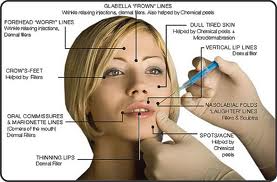
History of BOTOX


The BOTOX toxin was extracted from the bacteria that are responsible for food
poisoning (Bocholina) during the late 60's to the early 70's.
Initially, the toxin was used for eye muscle problems, e.g. in cases where one eye
muscle is weaker and the other stronger ('squint'), the toxin is injected into the stronger
eye muscle - relaxing it - and thus resulting in permanent correction of the problem.
The toxin only commenced being used for the treatment of cerebral palsy in the latter
part of the 70's; and even then, it wasn't until '1995 that it was officially approved for use
for persons under '12 in Canada. In this respect, Canada is ahead of the U.S.A. in that
the latter has not yet officially approved the use of BOTOX in under 12's.
There are seven (7) neurotoxins of which the most commonly used is BOTOX A. It was
the first to be discovered and is used clinically.
Cerebral Palsy affects mainly the muscles, in particular where the nerves - or neuros -
come into the muscle of the limb and where they (nerves and muscles) attach. This
place where they attach is known as the neuro-muscular junction. As the nerves
transmit impulses across the neoro-muscular junction, the muscles contract and this
causes involuntary spastic movements. Administration of BOTOX by injection stops this
and stabilizes movement.


Who benefits from BOTOX?


Not everyone needs to have his or her spasticity removed. Some patients need to
have some degree of spasticity in order to walk, stand, etc. In other words, some
patients rely on their spasticity for their strength and removing it would weaken them.
Children born with Cerebral Palsy should have BOTOX injections as early as possible
before their muscles contract and stay permanently shortened. As they grow older and
their muscles are constantly in spasms, the children's muscles get shorter as the bones
grow longer and deformities occur. At this stage, it is too late to relax the muscles by
BOTOX injections but there is the option of surgery. All in all, younger patients are more
amenable to BOTOX than older ones hence the need to administer the toxin at an early
age.

Nerve and Muscle Blocks


A. Botox Injections (Botulinum type A toxin)


Children who benefit most from Botox are those who are too young for surgery or for whom
surgery is not yet warranted. Botox injections can provide an opportunity to evaluate the child’s
readiness for more permanent orthopedic procedures. In some cases, injections can provide
enough spasticity control that surgery can be avoided.

Botox injections can help improve a child’s ability to walk or use their hands and allow for a
better fitting orthotics by reducing spasticity. Therapists can take advantage of the time when an
overly powerful muscle is weakened to work on strengthening the muscle on the opposite side of
the joint (antagonist). Sometimes, casting of the involved extremity is done after the injection to
increase the stretch of the tight muscle.


When injected into the muscle, Botox interferes with the release of a chemical, acetylcholine, at
the junction of the muscle and nerve. This partially interrupts muscle contraction making the
muscle temporarily weaker. This becomes evident two to ten days after treatment and lasts
approximately 3 to 6 months.

Botox is currently being used to treat spasticity due to multiple sclerosis, head injury, stroke and
spinal cord injury. It has been used to relieve movement disorders of the head and neck, such as
torticollis. Most recently, botulinum toxin has been used successfully to treat spasticity in
children due to the muscle imbalances caused by cerebral palsy. “Dynamic deformities”
unresponsive to other treatments, may improve following Botox, delaying or preventing the need
for surgery or orthotics.

Procedure


Botox is injected directly into the spastic muscle where it diffuses only a short distance. It is
dosed according to total body weight and injections can be repeated after three months. Up to
10% of patients already have antibodies to botulinum toxin and may not respond to the
injections. Children should not be on an aminoglycoside antibiotic when Botox is injected as it
may also interfere with response to the Botox.

Botulinum toxin is injected through a very small needle much like an immunization, and side
effects are few. Local tenderness can occur but is related to the volume administered.
Occasionally there may be a skin irritation or rash. Sometimes a special needle is used which
electrically localizes the muscle where the Botox is needed. This medication can be injected in a
clinic setting with the option of using a topical anesthetic for the skin and/or mild sedation.

The reported side effects of this procedure include pain at the injection site and, in some cases,
generalized fatigue of short duration. This medication is felt to be very safe at the therapeutic
doses used. 


Benefits

The muscle relaxation resulting from Botox can provide comfort and ease of care for those
patients in whom spasticity causes pain or difficulty with hygiene.

1.  The effects of botulinum toxin are seen two days to ten days after the injection and the
 results last about three to six months.

2.  If you choose Botox as the method to decrease the spasticity, please read the following:

a)  We will use a topical cream to numb the area of the injection.  This takes
 about 30-45 minutes to start working.

b)  If we are doing several injections, without anesthesia, we may need to give
 another medicine to make the procedure easier for your child to tolerate.
 Therefore, please don't eat or drink anything two hours before your
 appointment. 

c)  We will need to see you back in clinic in one week after your injection to start
 a serial cast program.

Summary :
Overall, Botox provides a non-operative way to manage spasticity in a relatively pain- and risk-
free manner.
.

side effects

BOTOX and BOTOX Cosmetic?
Other side effects of BOTOX and BOTOX Cosmetic include:


•  dry mouth
•  discomfort or pain at the injection site 
•  tiredness
•  headache
•  neck pain
•  eye problems: double vision, blurred vision, decreased eyesight, drooping eyelids, swelling of your eyelids, and dry eyes. 
•  urinary tract infection in people being treated for urinary incontinence
•  inability to empty your bladder on your own and are being treated for urinary incontinence. 
•  allergic reactions. Symptoms of an allergic reaction to BOTOX

or BOTOX Cosmetic may include: itching, rash, red itchy welts,
wheezing, asthma symptoms, or dizziness or feeling faint. Tell your doctor or get medical help right away if you are wheezing or
have asthma symptoms, or if you become dizzy or faint.

Tell your doctor if you have any side effect that bothers you or that does not go away.


Related Posts Plugin for WordPress, Blogger...

extremetracking

eXTReMe Tracker

Featured Posts